


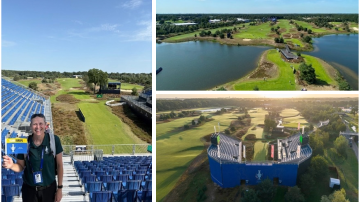
For Brightwood Golf & Country Club Superintendent Sue Crawford, the opportunity to volunteer at the Solheim Cup was far more than a chance to be around one of the biggest events in women’s professional golf. It was an opportunity to learn, connect with turf professionals from around the world, and gain a broader perspective on what it takes to succeed as a golf course superintendent.
Hosted at Bernardus Golf in Cromvoirt, Netherlands, the Solheim Cup brought together the world’s best players and a massive international team behind the scenes to prepare and maintain the golf course at the highest level.
Crawford described the experience as one she will remember throughout her career.
From being treated like a VIP and enjoying incredible food to experiencing the energy of the crowds, Crawford was impressed by every aspect of the event. The Bernardus Golf property itself left a lasting impression.
“I doubt I’ll ever be on a nicer golf course,” Crawford said.
The course was unique, with fescue used across all playing surfaces and no traditional rough. Naturalized areas between holes featured heath and trees, while the property itself had previously been farmland before Bernardus Golf was developed.
But while the golf course and atmosphere were spectacular, it was the work taking place behind the scenes that provided Crawford with some of the most valuable lessons.
105 People, 84 Volunteers and a 4:00 a.m. Start
Preparing a golf course for a Solheim Cup is an enormous operation.
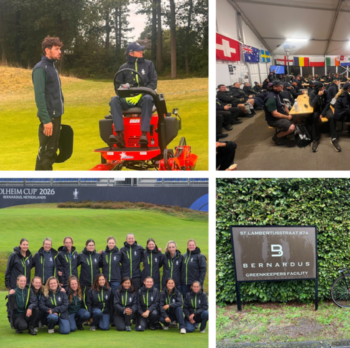
The maintenance team consisted of 105 people, supported by 84 volunteers representing 22 different countries. Every morning, the operation began long before the first tee time, with maintenance equipment leaving the facility at approximately 4:00 a.m.
The team was divided into specialized roles, including:
- 22 people mowing greens
- 11 people mowing fairways
- 8 people mowing surrounds
- 6 people changing holes
- 24 people raking bunkers
- 6 people mowing tees
- 5 people rolling greens
- 4 people collecting data
Crawford spent her mornings rolling greens, while her evenings were generally spent on the fairway divot-filling crew.
The target green speed for the championship was 10.5 feet, requiring an incredible level of preparation, consistency and attention to detail.
For Crawford, being part of that operation offered a perspective that simply cannot be gained from watching a professional tournament from the gallery.
Learning From the Best
One of the biggest benefits of the experience was the opportunity to work alongside turf professionals from clubs and facilities around the world.
Crawford was able to exchange ideas, learn different approaches to course preparation and build relationships with people she may work with again throughout her career.
The experience also expanded her professional network, creating opportunities to volunteer at future major events, connect with potential speakers for the annual turfgrass conference and develop relationships throughout the industry.
Most importantly, Crawford came away with a broader understanding of what it means to be a successful superintendent.
More Than Growing Grass
While technical turf management is obviously a major part of the job, Crawford believes her experiences at major championships have reinforced that being a successful superintendent requires much more.
“Anyone can learn to grow grass, but it takes work to be a good leader, an effective communicator, and an adaptable problem solver.”
That perspective is perhaps the most valuable takeaway from Crawford’s time at the Solheim Cup.
Working at a championship of this magnitude provided an opportunity to see firsthand how communication, teamwork, preparation and leadership come together to create a world-class playing surface.
For Crawford, volunteering at the Solheim Cup and previously at events such as the Presidents Cup has become one of the most memorable aspects of her career. The knowledge, relationships and perspective gained through these experiences will continue to benefit her work at Brightwood Golf & Country Club and contribute to the broader turfgrass community here in Nova Scotia.
Looking Ahead
Crawford’s Solheim Cup experience is a great example of the opportunities available to Nova Scotia’s golf industry professionals when they step outside their home facilities and become part of the global golf community.
From the early-morning maintenance operation to the final putt, the Solheim Cup demonstrated the incredible amount of work required behind the scenes to deliver professional golf at the highest level.
For Sue Crawford, it was an experience that went far beyond maintaining a golf course. It was an opportunity to learn, connect, lead and grow as a professional and one that she will carry with her throughout the rest of her career.